SB

Forthcoming

The Civilization We Choose

Humanity, Power, and Meaning in the Age of AI

Serdar Bahar, PhD

For the first time, we are asking a technology not only to work for us, but to think with us.

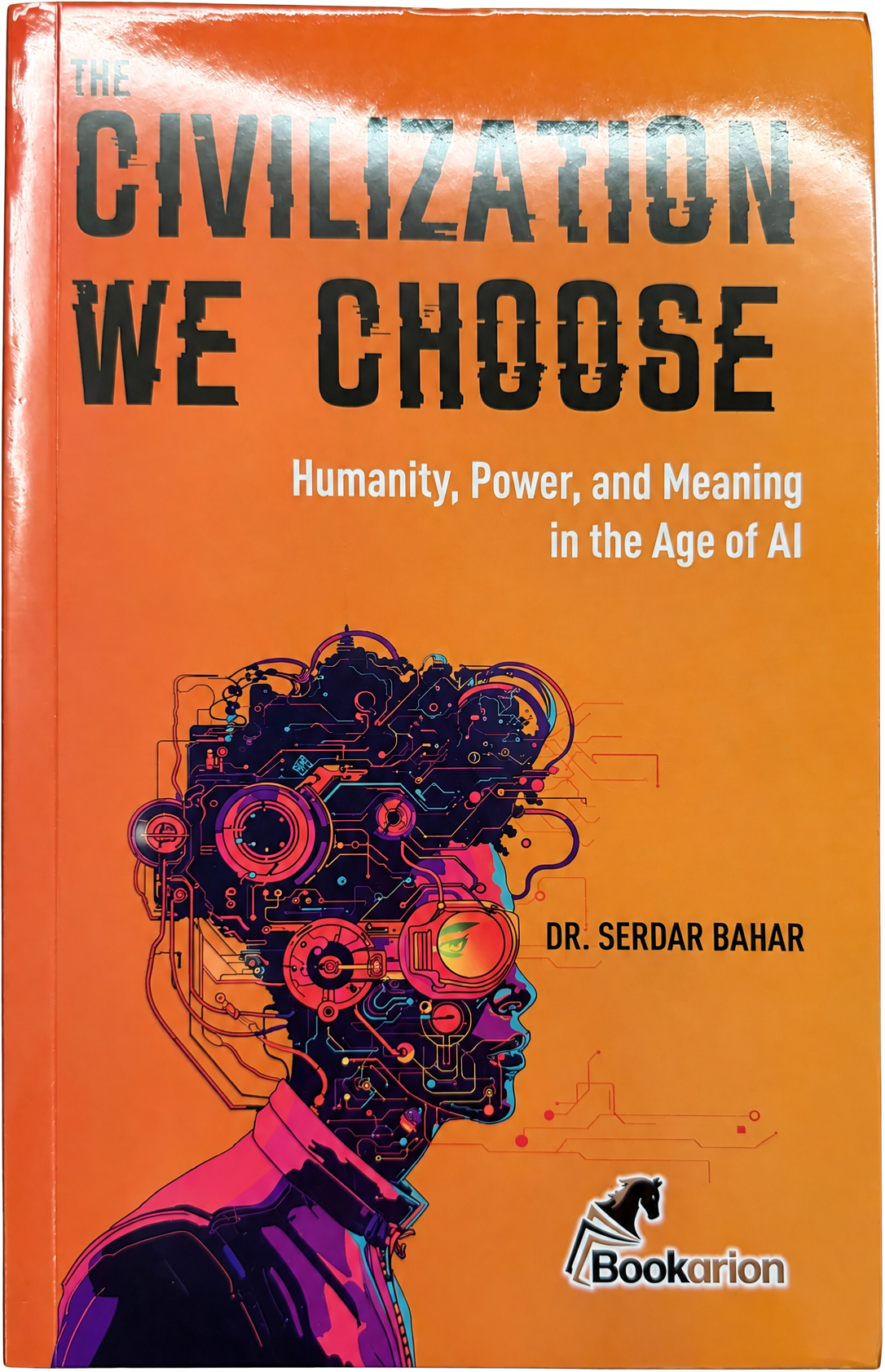
The Civilization We Choose: Humanity, Power, and Meaning in the Age of AI — Dr. Serdar Bahar. Cover of the English edition.

About the book

The questions are human.

The Civilization We Choose looks beyond what AI can do to examine what it could mean for purpose, judgment, power, and responsibility.

Drawing on history, economics, philosophy, psychology, and technology, the book offers not certain predictions, but a clearer way to examine the choices ahead.

Three questions at the heart of the book

For leaders, policymakers, and readers navigating the human consequences of AI.

  1. 01

    If AI creates economic abundance, where will people find meaning and purpose?

  2. 02

    If we delegate parts of our thinking to machines, how will our judgment change?

  3. 03

    When humans and AI think together, who remains responsible for the decisions?

A distinctive feature

From AI's Perspective

Artificial intelligence is not only the subject of the book. It is also part of the method.

Short sections titled “From AI's Perspective” challenge the author's arguments, question assumptions, and introduce alternative viewpoints.

AI is not presented as a conscious thinker. It is used as a nonhuman cognitive system through which the author can examine—and disagree with—his own ideas.

Inside the book

Six chapters.
One human choice.

From past revolutions to the distribution of power and the futures still open to us.

  1. Chapter 01

    The Common Pattern of Great Transformations

    When does a technology stop being a tool and begin changing civilization?

    Agriculture, industry, and the internet reshaped far more than production: they changed human behavior and social institutions. This chapter asks whether AI represents a comparable turning point—one that could transform our relationship with our own thinking.

  2. Chapter 02

    The Abundance Paradox

    If economic scarcity decreases, what happens to our need for meaning?

    Greater abundance may solve material problems without resolving the human need for purpose. Drawing on Frankl, Arendt, and Maslow, this chapter explores why people need not only to consume, but also to contribute, belong, and feel useful.

  3. Chapter 03

    The Externalization of Thinking

    What do we gain—and what might we lose—when we delegate judgment to AI?

    AI extends the history of tools that support memory and calculation into interpretation, evaluation, and recommendation. The chapter examines automation bias, verification, and cognitive inequality through a simple challenge: faster, more convincing answers do not necessarily mean better thinking.

  4. Chapter 04

    The New Geography of Power

    Who will control economic and political power in the age of AI?

    Computing capacity, chips, energy, data, models, and access rules form a new strategic layer of power. This chapter explores whether AI's value will be widely shared or concentrated among those who control the infrastructure behind it.

  5. Chapter 05

    How Can Humans and AI Think Together?

    Can AI improve human thinking without replacing human judgment?

    AI can identify patterns, generate alternatives, and challenge assumptions; humans bring experience, values, ethical judgment, and accountability. Thinking together, the chapter argues, must not mean surrendering the responsibility to think.

  6. Chapter 06

    The Next Civilization

    What kind of civilization will we choose to build?

    The final chapter brings the book's historical, economic, cognitive, and political questions together. Rather than predicting one future, it examines the choices facing governments, companies, education, work, and social institutions.

Possible directions

Five futures.
None inevitable.

These possibilities may coexist, even within the same society. The outcome depends on choices as much as capabilities.

  1. 01

    The Civilization of Abundance

    AI and automation expand access to goods, services, and opportunities.

  2. 02

    New Feudalism

    Control over infrastructure creates new dependencies and concentrated power.

  3. 03

    Cognitive Democracy

    Advanced intelligence helps more people participate in knowledge and public life.

  4. 04

    The Civilization of Comfort

    Convenience improves daily life while independence and responsibility may weaken.

  5. 05

    The Human Renaissance

    Relationships, creativity, experience, and meaning acquire renewed importance.

About the author

Serdar Bahar, PhD

Serdar Bahar is a product and technology executive and independent advisor to executives, boards, and founders.

A former CIO in financial services, his work spans enterprise AI, FinTech, and platform transformation—where technological possibility meets institutional and human choice.

Final perspective

The next civilization will not be determined by technology alone.

It will also be shaped by the choices we make.

Request publication updates

Purchase links will be added when available.

contact@serdarbahar.com

Two languages. Two editions.

Publication details will be announced.

English
The Civilization We Choose
Türkçe
Bir Sonraki Medeniyet